> For the complete documentation index, see [llms.txt](https://docs.chatlayer.ai/llms.txt). Markdown versions of documentation pages are available by appending `.md` to page URLs; this page is available as [Markdown](https://docs.chatlayer.ai/navigation/history/versions.md).
# Versions
Have you accidentally published a new version of your bot that contains a mistake? You can fix this by rolling back to a previous LIVE version of your bot.
{% hint style="info" %}
Learn more about LIVE and DRAFT environments [here](/publish/publishing-your-bot.md).
{% endhint %}
To go back to a previous LIVE version of your bot:
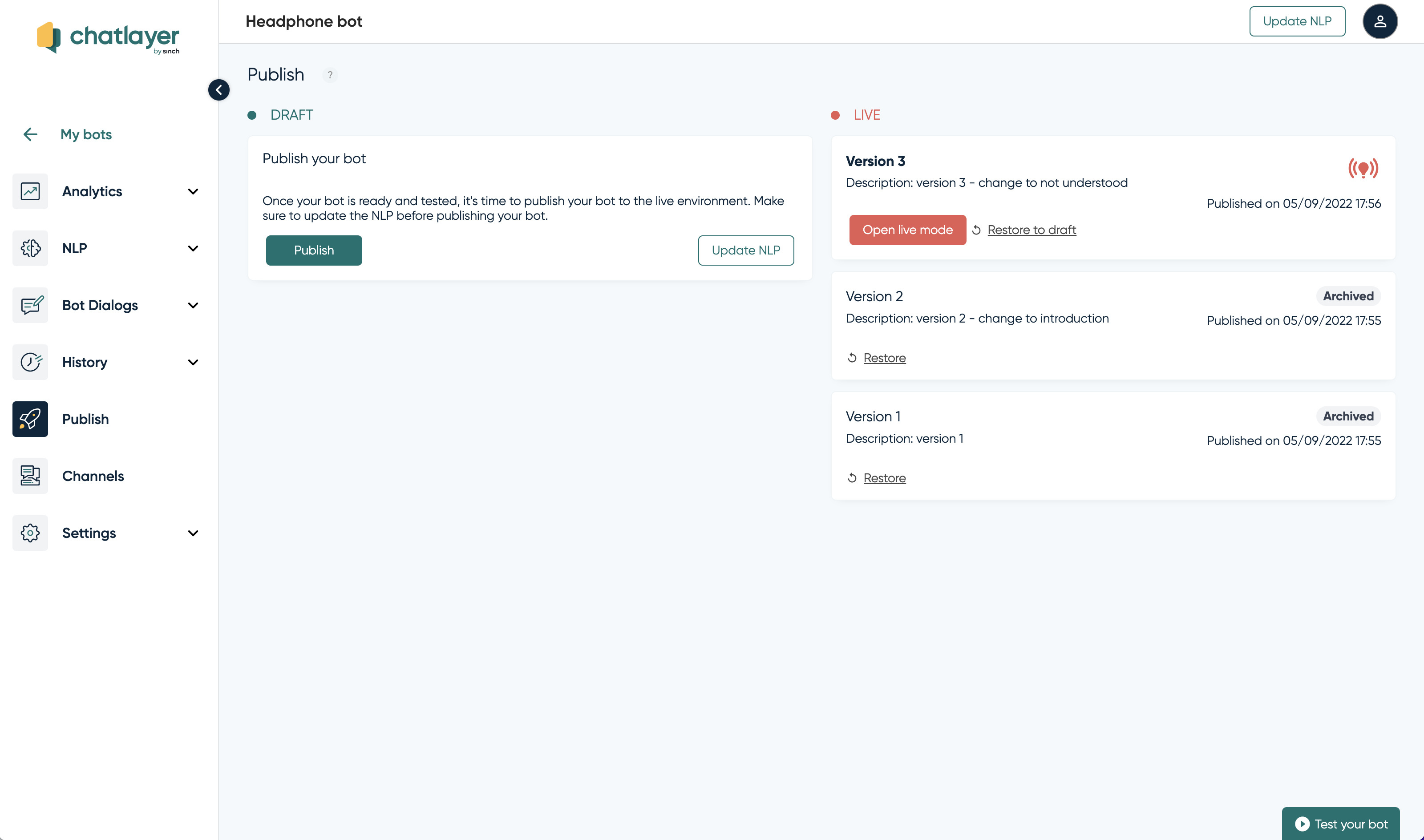
1. Open your bot and go to the "Publish" menu.
2. On the right hand side you can see all the LIVE versions you have published in the past.
{% hint style="info" %}
Need a refresher on what versions are and how they're used? Read more [here](/publish/publishing-your-bot.md).
{% endhint %}
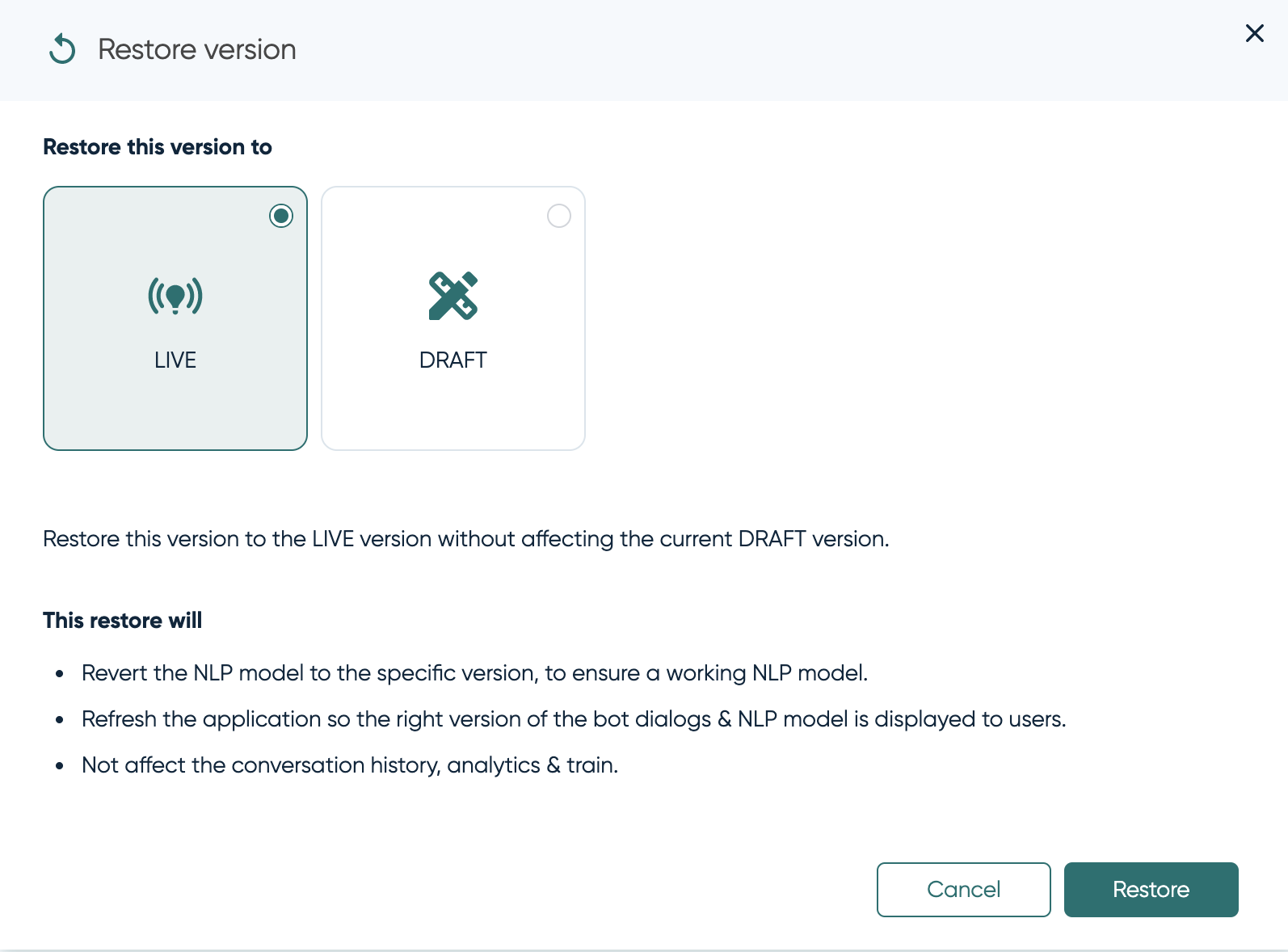
If you want to restore an older version, simply click the restore button on that version; the window below will be shown:
3. You can choose if you either want to:
* make this older version of the bot the new LIVE version that your users will talk to. This will not affect the current DRAFT version.
* load the older version into your DRAFT version, so you can continue working on it. This will not affect the current LIVE version.
{% hint style="warning" %}
Restoring a version to DRAFT means overwriting your current DRAFT version. This cannot be undone.
{% endhint %}
Restoring your bot will:
* Revert the NLP model to the specific version, to ensure a working NLP model.
* Refresh the application so the right version of the blocks & NLP model is displayed to users.
* Not affect the conversation history, analytics & train tab.
---
# Agent Instructions
This documentation is published with GitBook. GitBook is the documentation platform designed so that both humans and AI agents can read, navigate, and reason over technical content effectively. Learn more at gitbook.com.
## Querying This Documentation
If you need additional information that is not directly available in this page, you can query the documentation dynamically by asking a question.
Perform an HTTP GET request on the current page URL with the `ask` query parameter, and the optional `goal` query parameter:
```
GET https://docs.chatlayer.ai/navigation/history/versions.md?ask=&goal=
```
`ask` is the immediate question: it should be specific, self-contained, and written in natural language.
`goal` is optional and describes the broader end goal you are ultimately trying to accomplish on behalf of the user. GitBook uses it to tailor the answer towards what is most useful for that goal.
The response will contain a direct answer to the question and relevant excerpts and sources from the documentation.
Use this mechanism when the answer is not explicitly present in the current page, you need clarification or additional context, or you want to retrieve related documentation sections.